Gold Cura
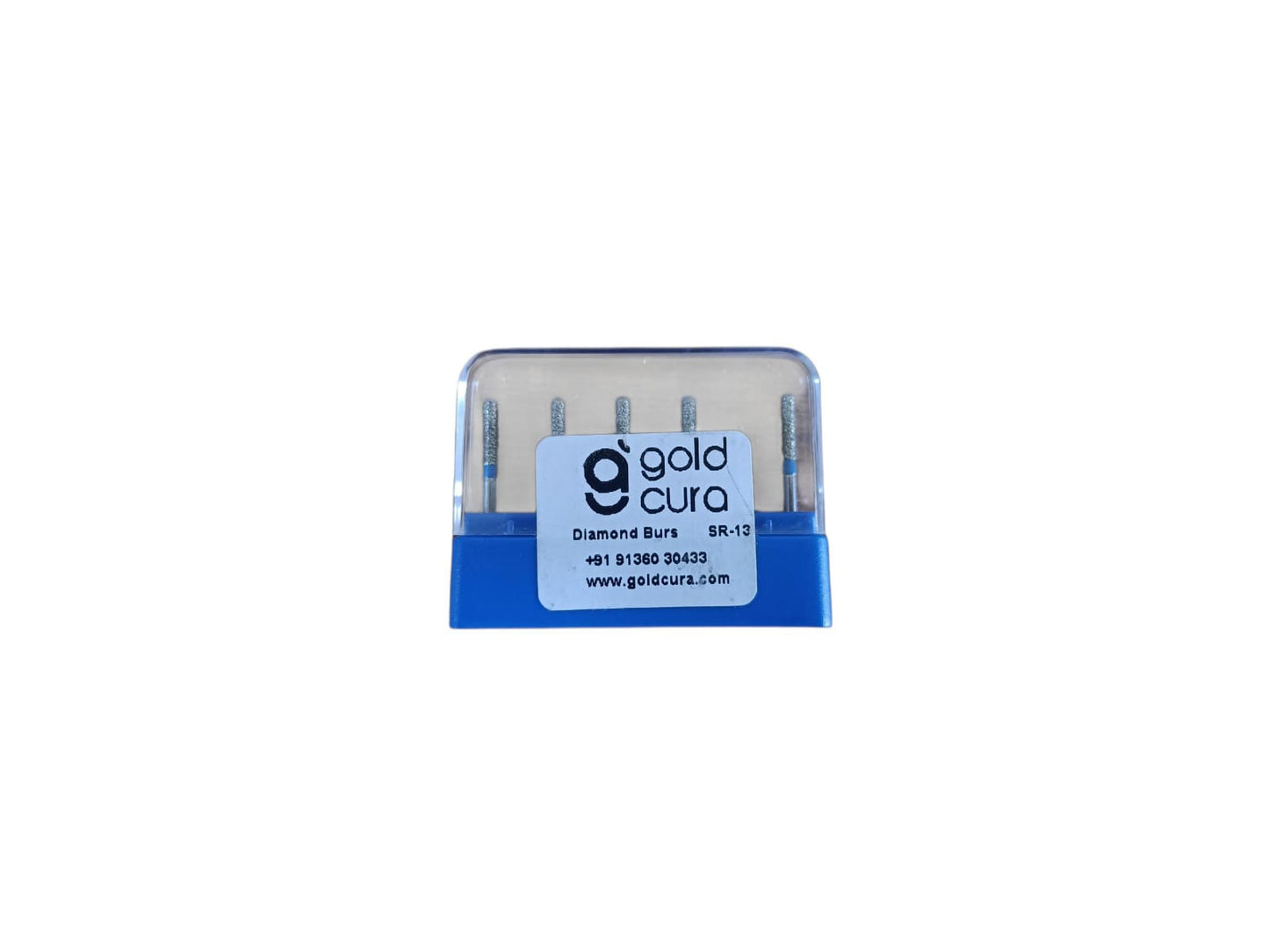
Gold Cura Straight Round-End Cylinder Diamond Burs FG – SR-11 to SR-13, Pack of 5
In stock
Couldn't load pickup availability
In stock. Estimated delivery within 4–5 working days.
Quick Answer
Direct answer: Gold Cura Straight Round-End Cylinder Diamond Burs FG are parallel-sided, round-ended friction-grip dental diamond burs used for controlled cavity and restorative preparation, wall shaping, selected crown preparation, inlay and onlay preparation, and smoothing internal line angles.
Direct answer: Gold Cura Straight Round-End Cylinder Diamond Burs FG are parallel-sided, round-ended friction-grip dental diamond burs used for controlled cavity and restorative preparation, wall shaping, selected crown preparation, inlay and onlay preparation, and smoothing internal line angles. Choose SR-11, SR-12 or SR-13. Each order contains 5 identical burs of the selected size.
Straight Round-End Diamond Burs: Key Facts
| Bur category | Straight round-end cylinder dental diamond burs |
|---|---|
| Available codes | SR-11, SR-12 and SR-13 |
| Head geometry | Parallel-sided cylinder with a rounded working end |
| Shank type | FG / friction grip |
| Compatible handpiece | Compatible high-speed friction-grip dental handpiece |
| Pack size | 5 identical burs of the selected code |
| Typical applications | Cavity preparation, restorative wall shaping, selected crown preparation, inlay/onlay preparation and rounded internal contouring |
| Intended user | Trained dental professionals |
What Is a Straight Round-End Cylinder Diamond Bur?
A straight round-end, or round-ended cylinder, bur combines straight parallel sides with a rounded tip. The cylindrical sides help shape and refine preparation walls, while the rounded end helps create smoother internal transitions than a flat-ended straight fissure bur.
This geometry is different from a ball-round bur. A ball-round bur has a spherical head and is commonly selected for entry, excavation and rounded access. An SR bur has a longer cylindrical working surface and is selected when the clinician needs controlled wall shaping together with rounded internal line angles.
When Are Straight Round-End Diamond Burs Used?
- Controlled cavity preparation and restorative wall shaping
- Smoothing rounded internal line angles and transitions
- Selected axial reduction and crown-preparation procedures
- Inlay and onlay preparation and refinement
- Refining internal and external restorative contours
- Enlarging or regularising a preparation while preserving a rounded internal end form
- Procedures where a straight cylinder is preferred over a tapered or flat-ended shape
When to Use SR-11, SR-12 and SR-13
Size progression: SR-11 is the narrowest, SR-12 is the medium size and SR-13 is the widest. Common industry catalogues reference approximately 1.2 mm, 1.4 mm and 1.6 mm head diameters respectively. Confirm the dimensions printed on the Gold Cura packaging or supplied specification before clinical use.
| Code | Relative size | When to use it |
|---|---|---|
| SR-11 | Narrowest; common reference approximately 1.2 mm | Choose for conservative and narrower preparations, smaller teeth, restricted access, precise internal contouring and wall refinement where a wider cylindrical bur could remove unnecessary tooth structure. |
| SR-12 | Medium; common reference approximately 1.4 mm | Choose as the general-purpose size for routine cavity preparation, restorative wall shaping, selected crown preparation and inlay or onlay preparation when balanced access and cutting width are required. |
| SR-13 | Widest; common reference approximately 1.6 mm | Choose for broader preparations, larger posterior teeth, wider axial reduction and internal contouring when the planned preparation requires more cutting width than SR-11 or SR-12. |
Simple selection rule: choose the smallest diameter that safely creates the planned preparation. Increase to SR-12 or SR-13 only when the required wall width, tooth size and access justify a broader instrument.
Straight Round-End vs Other Diamond Bur Shapes
| Bur shape | Geometry | Typical selection |
|---|---|---|
| SR — Straight round-end cylinder | Parallel sides with rounded end | Wall shaping with smoother rounded internal transitions |
| SF — Straight fissure / flat-end | Parallel sides with flat end | Flat floors, box forms and straighter internal geometry |
| BR — Ball round | Spherical head | Initial access, excavation and rounded entry |
| TR — Taper round-end | Tapered sides with rounded end | Controlled taper with rounded internal line angles |
| TF — Taper flat-end | Tapered sides with flat end | Tapered walls and flat-ended preparation geometry |
How to Choose the Correct SR Diamond Bur
- Confirm the required geometry. Select an SR bur when straight cylindrical sides and a rounded working end suit the planned preparation.
- Assess tooth size and access. Smaller teeth and restricted spaces generally favour SR-11; broader posterior preparations may require SR-12 or SR-13.
- Choose the minimum required diameter. Avoid selecting a wider instrument solely for faster cutting.
- Confirm the intended internal form. Choose SF for a flat end, TR for a taper with a rounded end, or TF for a taper with a flat end.
- Confirm grit separately. The SR code identifies shape and relative size, not necessarily the abrasive grade.
- Verify handpiece fit. Use only in a compatible high-speed FG handpiece and confirm secure seating.
- Inspect before use. Do not use a bur that is bent, damaged, corroded, worn or no longer cuts efficiently.
Clinical Applications
- Direct restorative cavity preparation
- Parallel wall shaping and refinement
- Selected crown and indirect-restoration preparation
- Inlay and onlay preparation
- Rounded internal line-angle formation
- Restorative contour adjustment
- Preparation refinement in anterior and posterior teeth, according to the selected size and clinical plan
Grit, Speed, Dimensions and Processing Guidance
The SR code primarily identifies the straight round-end cylinder shape and relative diameter. Do not infer the exact grit, maximum RPM, sterilisation cycle, number of permitted reuses or replacement interval from another manufacturer’s catalogue. Confirm these details from the Gold Cura packaging, supplier specification or instructions supplied with the product.
- Use appropriate water cooling, pressure, speed and intermittent cutting technique for the selected procedure.
- Follow the supplied cleaning, disinfection, sterilisation, reuse and replacement instructions.
- Replace any bur that is damaged, bent, corroded, visibly worn or no longer cuts efficiently.
- Use only by trained dental professionals.
Frequently Asked Questions
What is a straight round-end cylinder diamond bur?
It is a parallel-sided cylindrical dental diamond bur with a rounded working end. The shape supports controlled wall shaping while creating smoother internal transitions than a flat-ended straight fissure bur.
What does SR mean in diamond bur codes?
SR refers to the straight round-end or round-ended cylinder shape family. The number identifies the relative diameter within this series.
Which sizes are available?
Gold Cura offers SR-11, SR-12 and SR-13. Each pack contains five identical burs of the selected size.
Which is the smallest size?
SR-11 is the narrowest option, followed by SR-12 and then SR-13. Common industry references list them at approximately 1.2 mm, 1.4 mm and 1.6 mm head diameter respectively; confirm the supplied Gold Cura specification before use.
When should SR-11 be used?
SR-11 is suited to narrower and more conservative preparations, smaller teeth, limited access and precise internal contouring when a wider cylindrical bur would remove unnecessary structure.
When should SR-12 be used?
SR-12 is the medium, general-purpose option for routine cavity preparation, restorative wall shaping, selected crown preparation and inlay or onlay preparation.
When should SR-13 be used?
SR-13 is the widest option for broader preparations, larger posterior teeth and wider axial or internal contouring where the clinical plan requires more cutting width.
How is a straight round-end bur different from a ball-round bur?
A ball-round bur has a spherical head for entry and rounded excavation. An SR bur has straight cylindrical sides with only the end rounded, making it better suited to shaping walls and rounded internal line angles.
How is it different from a straight fissure bur?
A straight fissure bur generally has a flat end and is selected for flat floors and sharper internal geometry. An SR bur has a rounded end for smoother internal transitions.
Is this a mixed pack?
No. Select SR-11, SR-12 or SR-13, and the pack contains five identical burs of that selected code.
Which handpiece is required?
These are FG or friction-grip burs for a compatible high-speed dental handpiece. Confirm secure seating before use.
What grit are these burs?
The SR code identifies the shape and relative diameter, not necessarily the grit. Confirm the abrasive grade from the Gold Cura packaging or supplied specification.
Can these burs be sterilised and reused?
Follow the cleaning, disinfection, sterilisation, reuse and replacement instructions supplied with the product. Do not assume a cycle or reuse limit that is not stated in those instructions.
Related Gold Cura Dental Burs
- Dental Burs & Bur Kits
- Ball Round Diamond Burs FG
- Straight Fissure Diamond Burs FG
- Taper Round Diamond Burs FG
- Taper Flat-End / Tapered Fissure Diamond Burs FG
- Fine Finishing Diamond Burs FG
- Chamfer Diamond Burs FG
Professional-use dental instrument. Confirm the selected profile, grit, dimensions, handpiece compatibility, clinical indication and supplied processing instructions before use.
Browse related products: Dental Diamond Burs.
Why Dentists Choose This Product
- Direct answer: Gold Cura Straight Round-End Cylinder Diamond Burs FG are parallel-sided, round-ended friction-grip dental diamond burs used for controlled cavity and restorative preparation, wall shaping, selected crown preparation, inlay and onlay preparation, and smoothing internal line angles.
- Compatibility: Confirm the required size, variant, equipment connection or intended use shown on this page before ordering.
- Package: 1 × pack containing 5 items as specified
How This Listing Compares with Similar-Looking Options
| Decision factor | This listing | Before choosing another option |
|---|---|---|
| Configuration | Direct answer: Gold Cura Straight Round-End Cylinder Diamond Burs FG are parallel-sided, round-ended friction-grip dental diamond burs used for controlled cavity and restorative preparation, wall shaping, selected crown preparation, inlay and onlay preparation, and smoothing internal line angles. | Confirm the exact size, model, material, connection or pack quantity required for the intended workflow. |
| Compatibility | Confirm the required size, variant, equipment connection or intended use shown on this page before ordering. | Do not assume that similar-looking products or accessories are interchangeable. |
| Package | 1 × pack containing 5 items as specified | Compare included parts and consumables, not only the product image. |
Delivery and Returns
Estimated delivery is within 4–5 working days. Eligible return requests must be raised within 24 hours of delivery and remain subject to Gold Cura’s return policy. Used, contaminated, opened hygiene-sensitive or sterilized items are not returnable.