Gold Cura
Gold Cura Black Super-Coarse Diamond Burs FG – B Series, Pack of 5
In stock
Couldn't load pickup availability
In stock. Estimated delivery within 4–5 working days.
Quick Answer
Black super-coarse FG diamond burs for rapid initial tooth reduction and gross crown or bridge preparation. Choose SF-11B, TF-13B or TR-13B; pack of 5 identical burs.
Direct answer: Gold Cura Black Super-Coarse Diamond Burs FG are aggressive friction-grip dental diamond burs intended for rapid initial tooth reduction, gross crown and bridge preparation, removal of pronounced surface irregularities and rough shaping before the preparation is refined with a green coarse, standard, fine or extra-fine instrument. Choose SF-11B, TF-13B or TR-13B. Each order contains 5 identical burs of the selected code.
Black Super-Coarse Diamond Burs: Key Facts
| Bur category | Black-band super-coarse dental diamond burs |
|---|---|
| Available codes | SF-11B, TF-13B and TR-13B |
| Head shapes | Straight flat-end cylinder, taper flat-end and taper round-end |
| Shank | FG / friction grip for a compatible high-speed dental handpiece |
| Pack size | 5 identical burs of the selected code |
| Primary stage | Early preparation: rapid reduction and gross contouring |
| Intended user | Trained dental professionals |
What Does the Black Band or B Suffix Mean?
Black colour coding is widely used in dental-bur catalogues for the super-coarse or ultra-coarse abrasive category. These burs are selected when cutting efficiency and bulk reduction are more important than the final surface finish. Exact grit size, ring colour, dimensions and maximum permissible speed vary by manufacturer, so another brand’s micron or RPM value should not be treated as a Gold Cura specification.
When to Use Each Black Super-Coarse Bur
| Code | Profile | When to use it |
|---|---|---|
| SF-11B | Narrow straight cylinder with a flat end | Choose for rapid reduction of straight or near-parallel axial walls, initial shoulder-style preparation, broad flat-surface cutting and creating a flat terminal area where a straight-sided profile is required. Its narrower working profile supports more conservative access than a broader cylinder. |
| TF-13B | Medium taper with a flat end | Choose for fast tapered axial reduction, shoulder or butt-joint preparation, inlay/onlay walls and preparations that require a definite flat-ended margin. The taper helps establish convergence while the flat end creates a flatter terminal form. |
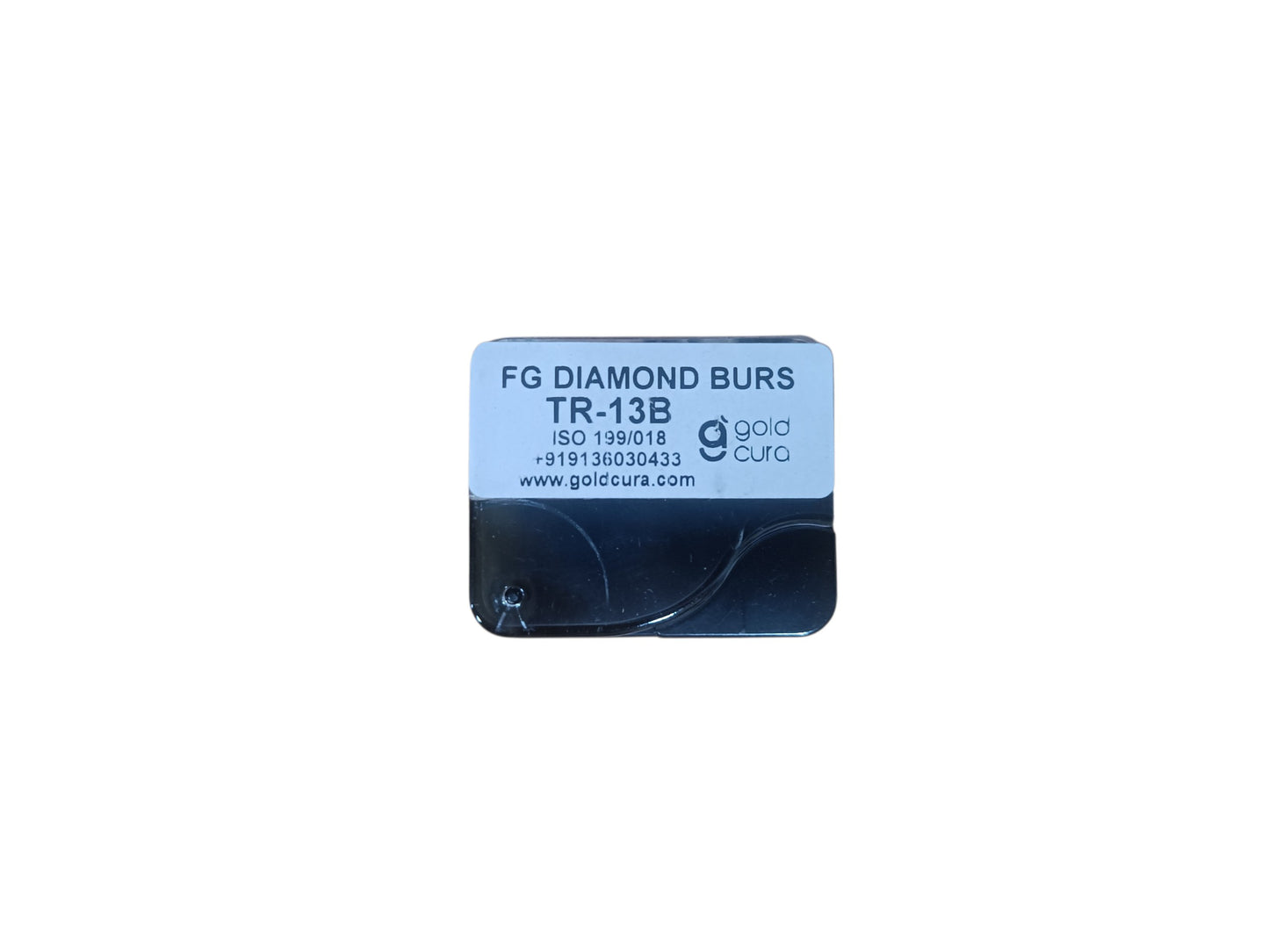
| TR-13B | Medium taper with a rounded end | Choose for general gross crown preparation, axial-wall reduction, rounded internal transitions and chamfer-style margins. The rounded end is preferred when a sharp internal line angle or flat shoulder is not intended. |
Simple selection rule: use SF-11B for straight walls and a flat terminal form, TF-13B for tapered walls with a flat end, and TR-13B for tapered walls with a rounded transition or chamfer-style finish line.
Black Super-Coarse vs Green Coarse Diamond Burs
| Category | Primary purpose | Typical workflow position |
|---|---|---|
| Black / super-coarse | Maximum cutting efficiency and rapid bulk reduction | Earliest reduction stage |
| Green / coarse | Efficient reduction with greater control than super-coarse | Early to intermediate shaping |
| Standard | General preparation and controlled shaping | Initial or intermediate stage |
| Fine / extra-fine | Margin refinement, contour correction and scratch reduction | Final preparation and finishing stages |
Common Clinical Applications
- Initial crown and bridge preparation
- Gross occlusal and axial reduction
- Rapid removal of pronounced enamel or restorative irregularities
- Rough shaping before margin refinement
- Selected ceramic crown removal or endodontic access work only when supported by the supplied instructions and clinical judgement
- Preparation before switching to a less aggressive diamond bur
How to Use Super-Coarse Diamond Burs Safely
- Plan the final preparation first. Select the bur geometry according to the intended wall taper and margin design.
- Use the smallest suitable working profile. An unnecessarily broad head can remove excess tooth structure or unintentionally change the preparation taper.
- Use light, controlled pressure. Super-coarse burs cut aggressively; force is not a substitute for a sharp, correctly selected instrument.
- Use adequate water cooling and intermittent contact. Follow the supplied bur and handpiece instructions.
- Maintain the intended path of insertion. Avoid rocking the bur or using the end geometry to create a margin it was not designed to produce.
- Stop before final finishing. Switch to an appropriate green coarse, standard, fine or extra-fine bur when the bulk reduction is complete.
- Inspect before use. Do not use a bur that is bent, damaged, corroded, visibly worn or does not seat securely.
Frequently Asked Questions
What are black diamond burs used for?
They are primarily used for rapid initial reduction and gross contouring before the preparation is refined with a less aggressive instrument.
Does black mean super-coarse?
Black is widely used as the catalogue colour for super-coarse or ultra-coarse diamond burs. Confirm the actual Gold Cura specification from the supplied packaging or instructions.
How many burs are included?
Each pack contains five identical burs of the selected code.
Is this a mixed pack?
No. Select SF-11B, TF-13B or TR-13B, and the pack contains five burs of that selected profile.
When should I use SF-11B?
Use SF-11B when rapid reduction is required along straight or near-parallel walls and a flat terminal form or shoulder-style preparation is planned.
When should I use TF-13B?
Use TF-13B for tapered walls with a flat-ended shoulder or butt-joint form.
When should I use TR-13B?
Use TR-13B for tapered axial walls, rounded internal transitions and chamfer-style crown preparation.
Can a black super-coarse bur create the final margin?
It can establish the gross form, but a less aggressive bur is normally required to refine and smooth the final margin.
Can these burs be used for crown removal?
Only when the selected bur, restoration material and supplied instructions support that use. Do not assume every super-coarse diamond is suitable for every restorative material.
Which handpiece is required?
These are FG friction-grip burs for a compatible high-speed dental handpiece.
What grit size are Gold Cura black burs?
The black category indicates an aggressive super-coarse class, but the exact micron specification should be confirmed from Gold Cura packaging or technical documentation.
Can they be sterilised and reused?
Follow the cleaning, disinfection, sterilisation, reuse and replacement instructions supplied with the product. Do not assume another manufacturer’s cycle or reuse limit.
Related Gold Cura Dental Burs
- Dental Burs & Bur Kits
- Green Coarse Diamond Burs FG
- Fine Finishing Diamond Burs FG
- Extra-Fine Diamond Burs FG
- Straight Fissure / Flat-End Cylinder Diamond Burs
- Taper Flat-End Diamond Burs
- Taper Round-End Diamond Burs
Professional-use dental instrument. Confirm the selected shape, grit, dimensions, handpiece compatibility, clinical indication and supplied processing instructions before use.
Browse related products: Dental Diamond Burs.
Need help selecting a bur? Use the Dental Diamond Bur Shapes Selection Guide to compare reduction, preparation and finishing profiles.
Why Dentists Choose This Product
- Black super-coarse FG diamond burs for rapid initial tooth reduction and gross crown or bridge preparation. Choose SF-11B, TF-13B or TR-13B; pack of 5 identical burs.
- Compatibility: For a suitable high-speed FG / friction-grip handpiece. These are aggressive reduction instruments; use controlled cooling and progress to an appropriate finer finishing sequence.
- Package: 1 × pack containing 5 items as specified
Delivery and Returns
Estimated delivery is within 4–5 working days. Eligible return requests must be raised within 24 hours of delivery and remain subject to Gold Cura’s return policy. Used, contaminated, opened hygiene-sensitive or sterilized items are not returnable.